|
|
|
Biographical Sketch
(13 October 2008)
|
| David W. Allan has authored over 100 papers in the field of precise time and frequency. He and his colleagues developed the Allan Variance which is at the heart of international time-keeping algorithms. |
David W. Allan was born in Mapleton, Utah on September 25, 1936. He received a B.S. degree in physics from Brigham Young University, Provo, Utah, in 1960, and an M.S. degree in physics from the University of Colorado in 1965.
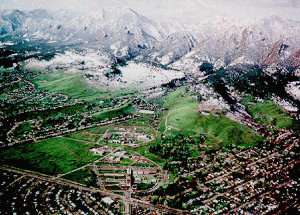
Aerial view of NIST Boulder Laboratories campus
(click image for enlargement)
In 1960 he joined the Atomic Frequency and Time Standards Section of the National Bureau of Standards (later renamed the National Institute of Standards and Technology -- NIST), Boulder, Colorado, where he worked with ammonia beam masers and related quantum electronic devices. After 1962 his work was directed toward the development of the atomic time scale system for the National Bureau of Standards which provides the time and frequency standard for the U.S.A. He coordinated this standard with other national and international timing centers, and provided its signal to be used to control radio stations WWV, WWVB, WWVH, GOES satellite time signals, the Automatic Computer Time System (ACTS), and to provide input to International Atomic Time (TAI) and Universal Coordinate Time (UTC) kept at the Bureau International des Poids et Mesures (BIPM).
He received the Department of Commerce Silver Medal award, 29 October 1968, "for contributions to the NBS atomic time scales and the understanding of the statistics of atomic frequency standards." In 1969 he received a visiting professor's grant from the Italian government to lecture and work at Istituto Elettrotecnico Nazionale Galileo Ferraris in Torino, Italy. In 1976 he was awarded the Industrial Research IR-100 award for developing a picosecond time difference instrument. The concepts in this instrumentation were later commercialized and are now the basis for the atomic clock measurements made at NIST in Boulder, at USNO in Washington DC and at several other international timing facilities.
In 1978 he received an Air Force invention award and patent, and was invited, along, with a colleague, to give a paper at the International Radio Scientific Union (URSI) in Helsinki on the "Practical Implications of Relativity for a Global Coordinate Time Scale". In 1981 he was invited under a United Nations Development Program as a consultant to New Delhi, India; and in 1982 he represented NBS as a guest scientist to give a series of lectures in the People’s Republic of China. In 1982 the Institute for Scientific Information identified one of his publications in their "Citation Classics" "as one of the most cited items in its field", only one other such paper had been cited to that date within his organization, the U.S. Dept. of Commerce. In May 1984 he was the second to receive the I. I. Rabi award -- named after the Nobel Prize winner who first thought of the atomic clock, and who was the first recipient of the award. This award was given at the annual Frequency Control Symposium "for his contribution to the measurement and characterization of precision time and frequency sources." In May 1985 he was invited to Leningrad to an International Astronomical Union (IAU) Symposium on Relativity and Celestial Mechanics to give a paper on "Coordinate Time in the Vicinity of the Earth." In September 1985 he was selected as an associate editor of Frequency and Time for one of the IEEE Transaction periodicals. In 1987 he was invited to give lectures in Israel and as a consultant to the Director of the National Physical Laboratory for improving the Israeli atomic time scale system. In 1988 he was asked to chair an international committee for interfacing the Defense Department's GPS satellite atomic clocks timing with the civilian sector throughout the world. And in 1989 he was asked to chair an international committee on setting standards for improving international timing via the Global Positioning System satellites. He has received numerous other awards, and he was the 1992 NIST nominee in physics for the Department of Commerce Gold medal. Part of the citation reads, "He 'wrote the book' on the...methods [for characterizing clocks and time and frequency distribution systems] and the statistical variance he introduced is named after him. Mr. Allan is as well recognized in the field of time and frequency technology as any other figure in the world."
The time scale algorithm he wrote in 1968 is still the basis of time as generated at NIST: UTC(NIST). A member of the group working at the International Time Bureau (BIH), was a guest worker with him after he wrote this algorithm, and some of the ideas were used by this guest worker to write the time scale algorithm ALGOS, which generates time for the world: TAI and UTC.
Mr. Allan has published well over a 100 technical papers and written chapters in several books. During the development of the USA's Department of Defense Global Positioning System (GPS), he was a consultant for the DoD for characterizing and using atomic clocks in space. Providing the idea and leadership for his team at NBS, he developed a very important and peaceful use of GPS for international time and frequency transfer -- called the GPS common-view technique. He sought after and obtained NASA JPL's support of this effort for use in synchronizing their Deep Space Network. The DSN requires synchronization of the atomic clocks in Canberra, Australia, Goldstone, California and Madrid, Spain to probe and track all of their outer space vehicles. This GPS common-view technique was also adopted by the several contributing nations toward the generation of International Atomic Time (TAI) and Coordinated Universal Time (UTC). UTC is the official time reference for the world. He also helped to set up this technique for the timing measurements of the class of spinning neutron stars called millisecond pulsars, and gave the world an improved understanding about the variations of the electron content between Earth and this newly discovered millisecond pulsar.
While last at NBS/NIST, he was a senior scientist in the Time and Frequency Division in the National Institute of Standards and Technology, and leader of the group which generates the NIST atomic time scales and who coordinate international time and frequency comparisons. Along with colleagues, he patented a "SmartClock" [PDF] technology, which has the potential to synchronize any clock incorporating the patent ideas so that it never needs to be set.
He officially retired from the government on 3 July 1992 and moved into a more independent consulting role. He continued with some of the committee work mentioned above, and was invited as USA expert for the Consultative Committee for the Definition of the Second -- a committee under the general umbrella of the Treaty of the Meter for the determination of basic international standards.
After his retirement, he moved his family to Utah, where he bought a farm, has constructed an all solar-gain home and has set up his consulting business. He has named his company Allan's Time Interval Metrology Enterprise (TIME).
His consulting work has been in the area of applied precise timing. This includes work with various companies supplying precise timing for the telecommunication and power industries, such as for Hewlett Packard -- then the maker of the most accurate commercial atomic clocks. His work has also been with companies who need precise timing for satellite communication and navigation systems. In this regard, he developed a technique for obtaining military level time accuracy without having a military receiver. Receivers using this technique have been deployed throughout the world for synchronizing telecommunications networks and wireless (cell-site) transmitters. This work stemmed from a "SmartClock" patent, that he invented just before leaving the lab in Boulder, CO. Hewlett-Packard bought rights to this patent, and he helped them develop their telecom, cell-site, GPS synchronization system, which became very pervasive in the industry.
Working with Professor Neil Ashby at the University of Colorado, he introduced a technique for providing global navigation accuracy that could potentially have an accuracy better than 1 centimeter for both the satellite as well as the user. It could also provide international timing at the 10 picosecond level. This technique has not yet been implemented, but has been appreciated by several high level people. It could greatly simplify as well as significantly improve the accuracy of the GPS, for example.
During 1997 through 1999, he and his wife accepted a call from their church to serve a mission in West Africa, Cote d’Ivoire, where they needed to learn to speak French. They had a great experience serving the people there and made many friends. They enjoyed significant success in their work and felt very rewarded for their time there. He also prepared and gave some lectures at the Universities and Air Force establishments while there.
While he was in Africa, John Wiley and Sons asked him to write a book on "GPS and Precision Timing Principles: Applications and Opportunities." He began that work after returning home. In conjunction with the research for this book, he discovered a new unified field theory – including a new theory of gravity. This work took priority over the writing of the book. He has performed seven experiments to date validating the new UFT. Most of this work is unpublished, but some of it can be found on this web site.
In 2001, he was joined in his research by Gus R. German, a BYU Electrical Engineer Masters Degree Graduate.
The week of 9/11 Gus and David were attending ION-GPS conference in Salt Lake City. Because about half of the presenters could not come because the airlines shut down, Mr. Allan was invited to give an impromptu paper – in which he was able to share some of their UFT results. These are published in the proceedings of that conference. This publication includes the discussion of a technology called Synchronistic Modulation Detection (SMD), which has very large implications for clock synchronization in telecommunications and navigation systems.
Because GPS was jammed during the Iraq war, David and Gus were invited to address this problem with some of their precision-timing technology. Out of this work has grown the EQUATE technology, which stands for an Ensemble of Quartz oscillators Adapting To the Environment. David and Gus joined with Bliley Technologies, the best quartz oscillator manufacturing company in the world, to help develop and manufacture this technology.
Recently, Congress added to the defense budget $4 million for the development of the EQUATE technology. The research to date has primarily been performed by David and Gus with significant support from Bliley. These funds will significantly accelerate the R&D of this technology, and should provide a major enhancement for the GPS as a defense system.
Mr. Allan has been a member of the Scientific Research Society of America, Sigma Xi, the International Telecommunications Union -Radio Division and was a very active member of the International Radio Consultative Committee (CCIR), the International Radio Scientific Union (URSI), and the International Astronomical Union (IAU). He is a senior member of the Institute of Electrical and Electronics Engineers (IEEE) and a member of the Institute of Navigation (ION). In June 1999 the ION named him a Fellow of the institute at a special recognition banquet in Boston. While serving in the IAU, he chaired for several years special sessions on millisecond-pulsar timing. He was also the original chair of the timing sub-committee for the GPS CGSIC (Civil GPS Service Interface Committee), where he served even after his retirement from the government and until the time of his mission to Africa.
David Allan’s mottos are "Truth is Light and Light is Love." To know and understand the TRUTH is his primary quest. His love of people and the history they have carved out in the context of "What makes us free?" are motivating to him, and he is active in promoting the freedoms provided by the founding fathers. He loves the mountains, and keeps himself fit by biking, cross-country skiing, and hiking. Over the years he has been an avid white-water river guide and photographer.
His studies include the search for the meaning and purpose of our time on planet Earth and its relationship to eternity. His desire is to bring forth light and truth in a way that will be most beneficial. Along these lines, his work on the new unified field theory has been most exciting along with experimentation associated therewith. He has an altruistic web site to help share the truths he has learned: www.allanstime.com.
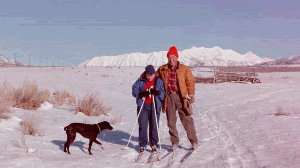
David, Edna and Winnie in their front yard

 | List of Publications by David W. Allan |
| David Allan's Solar Home Design |
| Index of Writings about Healthy Living |
| Index of Religious Writings by David W. Allan |
| Meet Edna Allan, Wife of D.W.A. |
| The Best Clock in the World ... and why we can't live without it (Discover Magazine's June 2000 Feature article on Boulder's Atomic Clock array) |
 |
|
|